2026-06-22
Real-Life Mario Kart in Tokyo: What It Actually Is (and Isn't)
Real-life Mario Kart in Tokyo is a road-legal street go-kart tour with no link to Nintendo, and no track: you drive real public streets. Here is what it actually is, where it is, what it costs, and what you need to drive one.
 By Mia Nakamura, licensed Tokyo guide since 2022
Search for "real-life Mario Kart in Tokyo" and you picture the game: red shells, rainbow road, a Mario hat. The real thing is both less and more than that, and the gap trips people up. I have guided this run since 2022, so let me clear up what it actually is, where you do it, and what you need to drive one.
Is the Tokyo go-kart tour actually Mario Kart?
No, and the name is the first thing to clear up. It is a guided street go-kart tour with no link to Nintendo, and has not had one since 2020. The original operator lost a court case over Mario costumes, so today the karts and outfits are generic. "Mario Kart" is just the phrase travelers reach for.
The company once branded MariCar let customers drive in Nintendo character costumes, and Nintendo sued. The Tokyo District Court ruled against it in September 2018 and awarded 10 million yen, the IP High Court raised the damages to 50 million yen and ordered the MariCar name dropped in January 2020, and the Supreme Court of Japan finalized Nintendo's win on 25 December 2020. Since then, the carts carry "unrelated to Nintendo" notices and no legitimate operator hands you a Mario hat.
So the search term sticks around even though the thing it describes has moved on. Honestly, that works out fine. The appeal was never the cartoon plumber, it was driving a tiny open kart through one of the busiest cities on earth, and that part is completely intact. If your real question is whether the whole thing survived the lawsuit, the short answer is yes: see can you still go-kart in Tokyo for what the courts actually changed.
Here is where expectation and reality part ways, point by point.
| What people expect | What it actually is |
|---|---|
| Nintendo's official Mario Kart | A guided street go-kart tour with no link to Nintendo, and none since 2020 |
| A Mario hat and character costume | Generic costumes only: superheroes, animals, cartoon onesies, no Nintendo characters |
| A closed race track with rails | Real public roads in live traffic, no track, no rails, stopping at the same red lights as everyone else |
| Red shells and rainbow road | An open kart sitting low to the ground, eye-level with taxi bumpers under towering billboards |
| Anyone can hop in and drive | At least 18, with a home license plus a 1949 Geneva Convention IDP carried as paper originals |
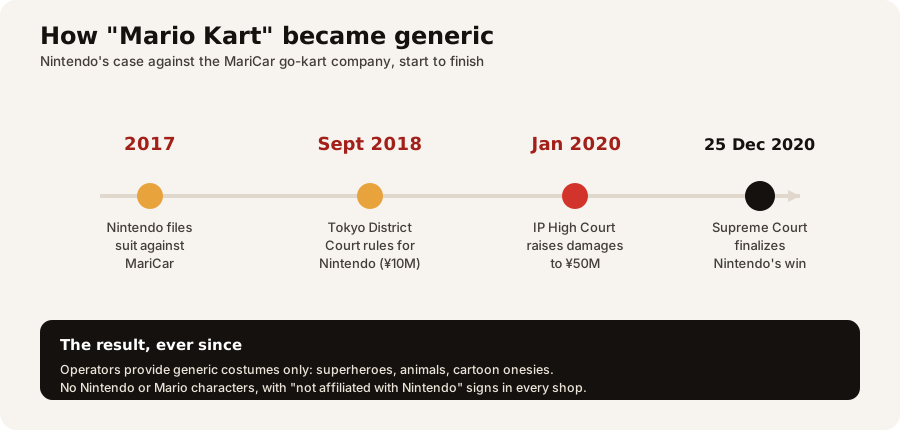
The Nintendo / MariCar legal timeline
| When | What happened |
|---|---|
| 2017 | Nintendo files suit against MariCar (Mari Mobility) |
| September 2018 | Tokyo District Court rules for Nintendo (¥10 million) |
| Jan 2020 | IP High Court raises damages to ¥50 million |
| 25 December 2020 | Supreme Court of Japan finalizes Nintendo's win |
Why no operator gives you a Mario costume today. Sources: Japan Today, Tokyo Weekender.
So what is the Tokyo go-kart tour really?
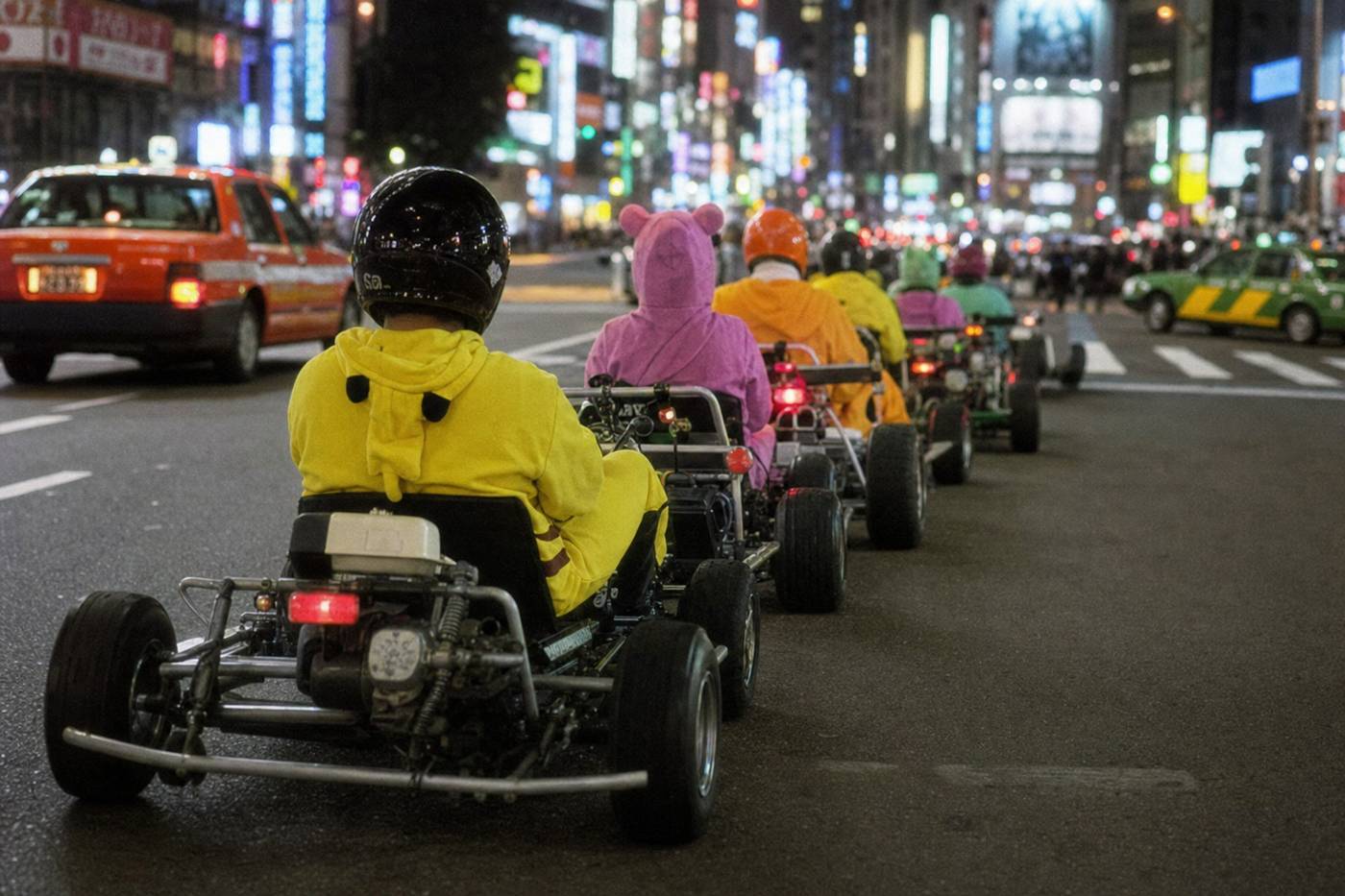
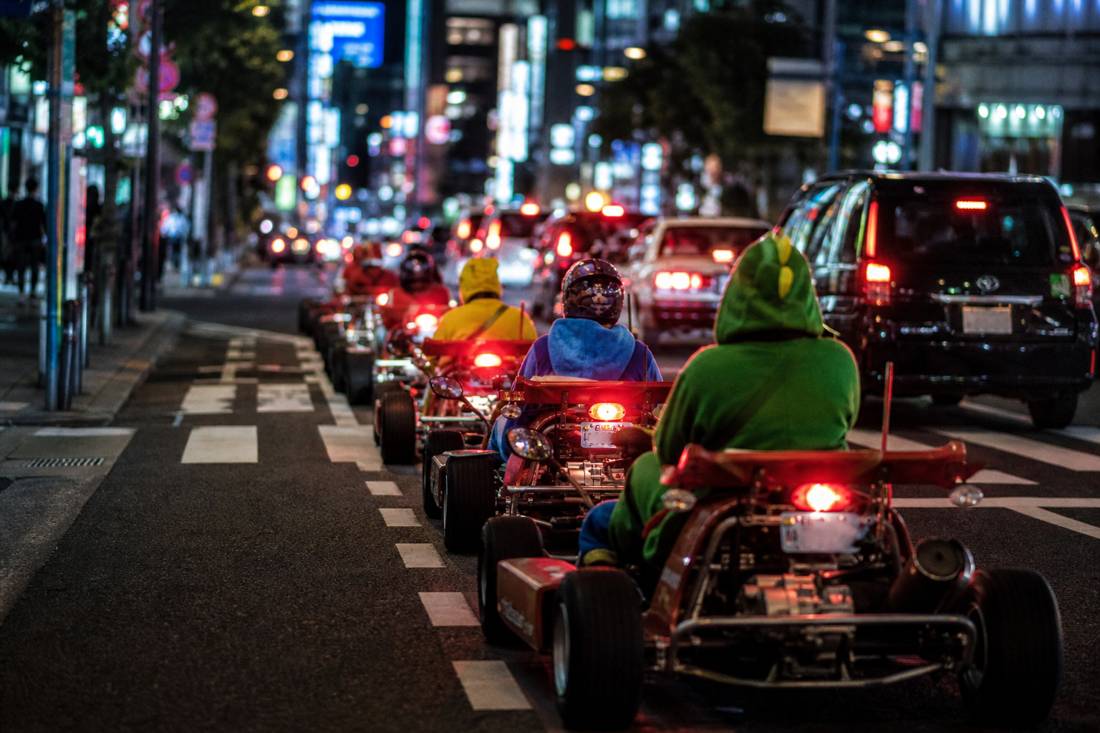
It is a road-legal go-kart you drive yourself on Tokyo's public streets in live traffic, in costume, following a guide in a small convoy. Each tour runs about an hour, with roughly 40 minutes of actual driving, past landmarks like the Shibuya Crossing or the Akihabara neon.
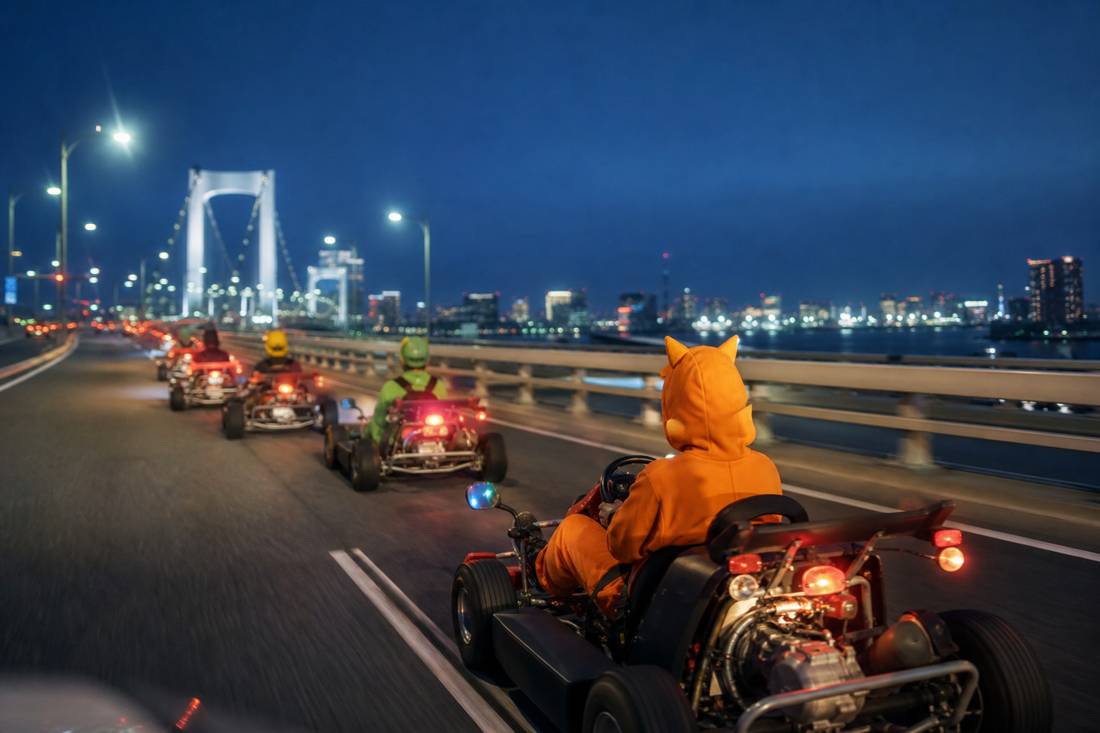
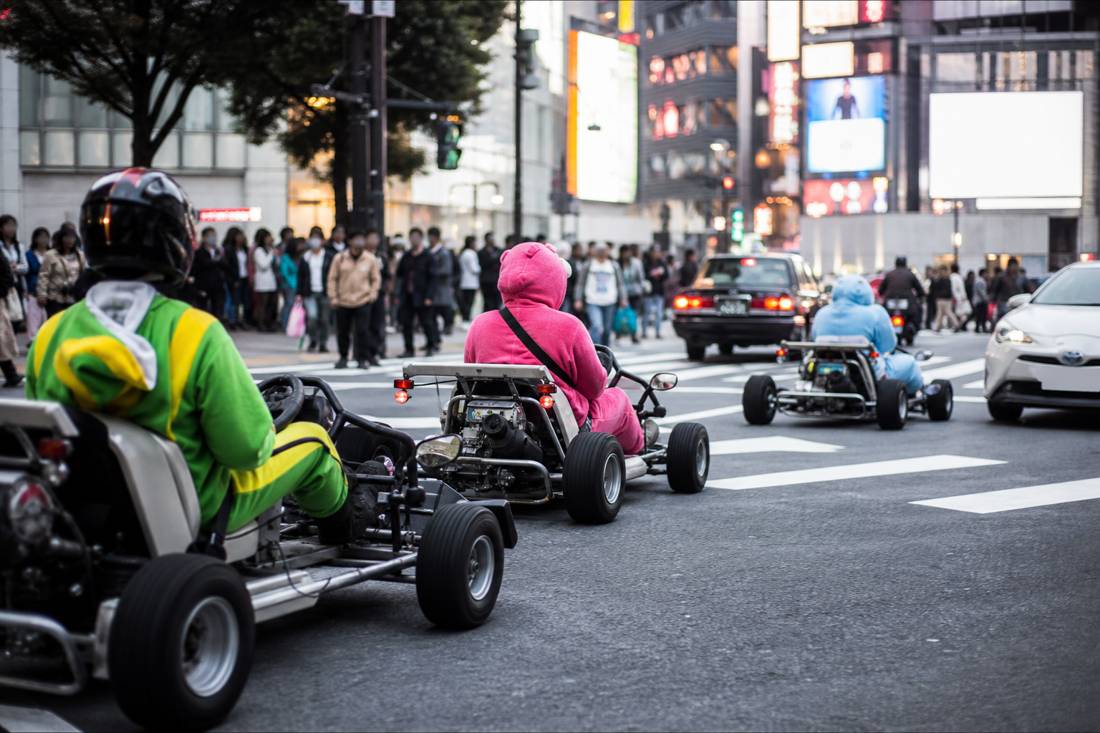
The karts sit low to the ground, which changes everything. From that seat the city feels enormous: you are eye-level with taxi bumpers, the billboards tower over you, and pedestrians look down and grin. There is no track and no rails. You are in the same lanes as delivery vans, stopping at the same red lights, which is exactly what makes it feel real rather than staged.
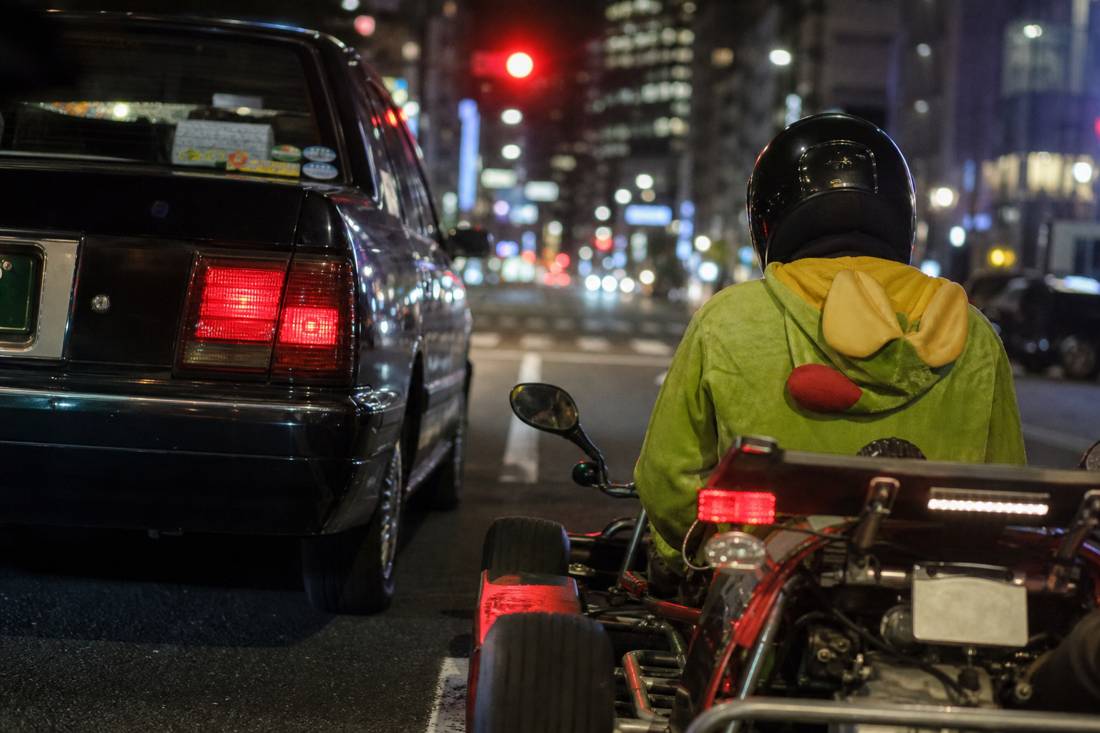
That is also why people describe it the way they do. Browse the reviews and you see the same words over and over: it felt like a video game, it felt cinematic, it was the most fun night of the trip. The gap between a screen and real Tokyo asphalt is the whole product, and it is a big part of why I think Tokyo go-karting is worth it even without the Nintendo branding.
Can you still dress up?
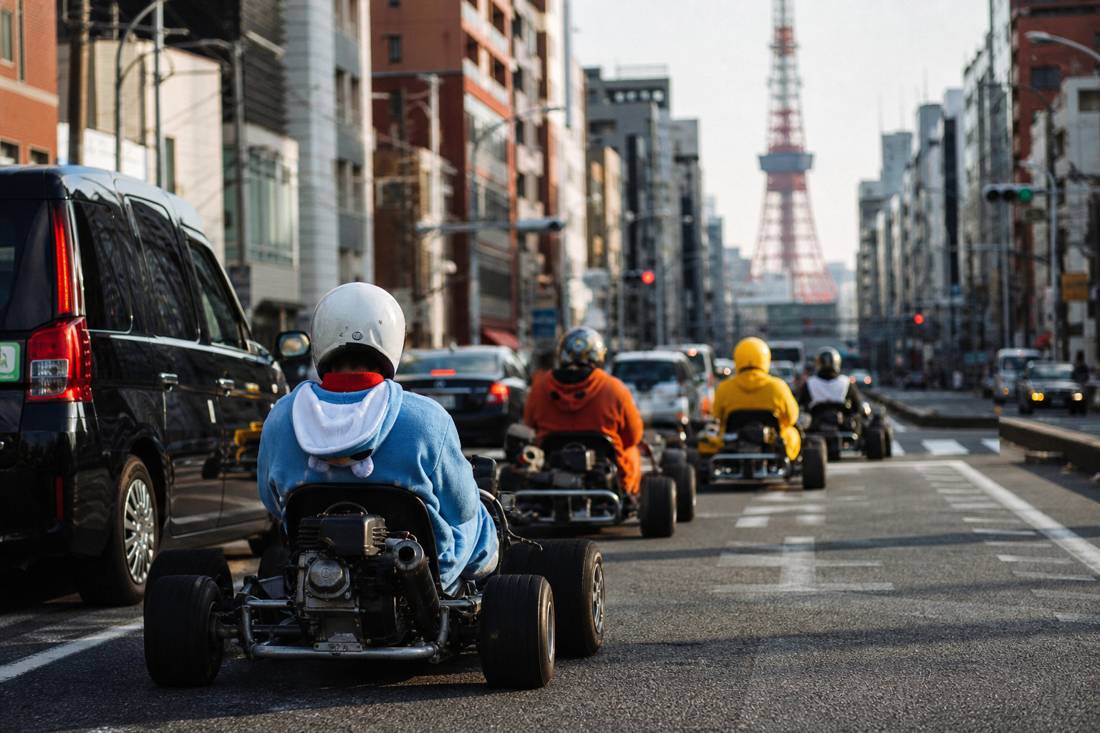
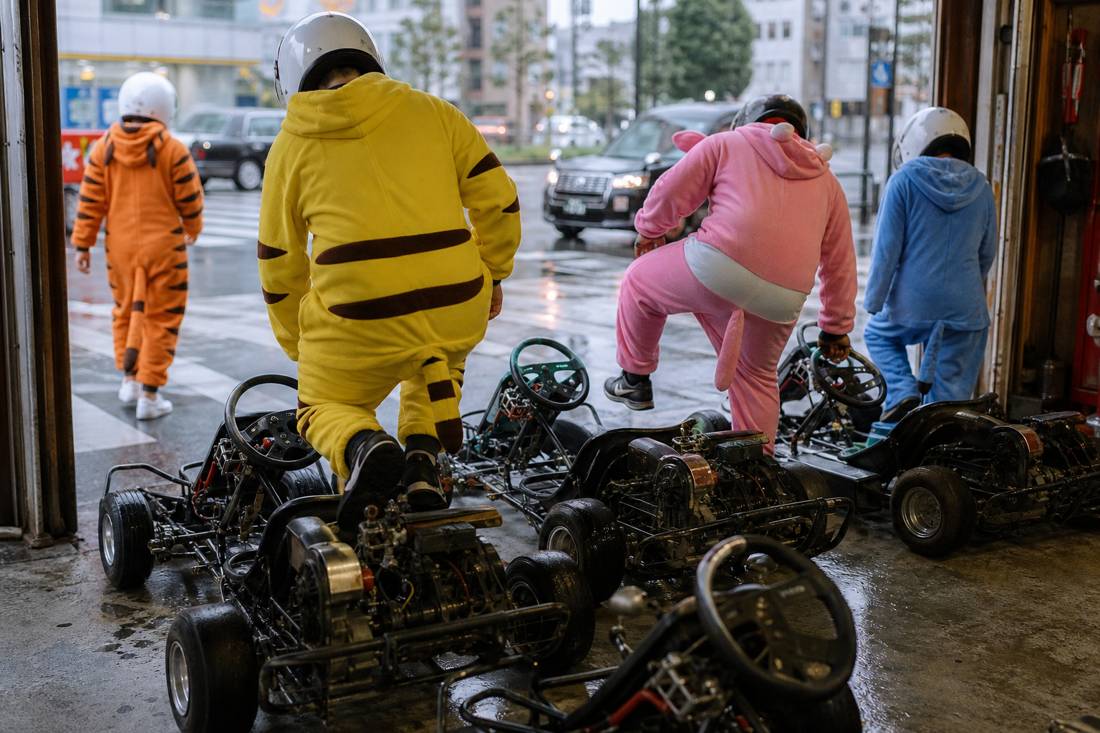
Yes, and most people do. Operators provide generic costumes, superheroes, animals, cartoon onesies, included in the price and usually one size. The only rule is no Nintendo or Mario characters, since that is precisely what the 2020 court case was about.
You pick your costume at the shop before you set off, and you pull it on over your clothes, so wear something you can move in. Nobody forces you into one, but almost everyone takes part, because the costumes are half the reason the photos land. A convoy of superheroes waiting at a Shibuya red light gets a reaction from the crowd that a row of plain karts never would, and that crowd is part of what makes driving Shibuya Crossing in a go-kart the shot everyone wants.
If you were specifically hoping to be Mario, I understand the small letdown. In practice, riders forget about it within a block. The novelty is the driving and the costume together, not the licence on the costume.
What do you need to drive one?
You need your home-country driver's license plus an International Driving Permit under the 1949 Geneva Convention, both as paper originals, carried with your passport, and you must be at least 18. Drivers from six countries use an official Japanese translation instead. A 1968 Vienna Convention IDP is not accepted.
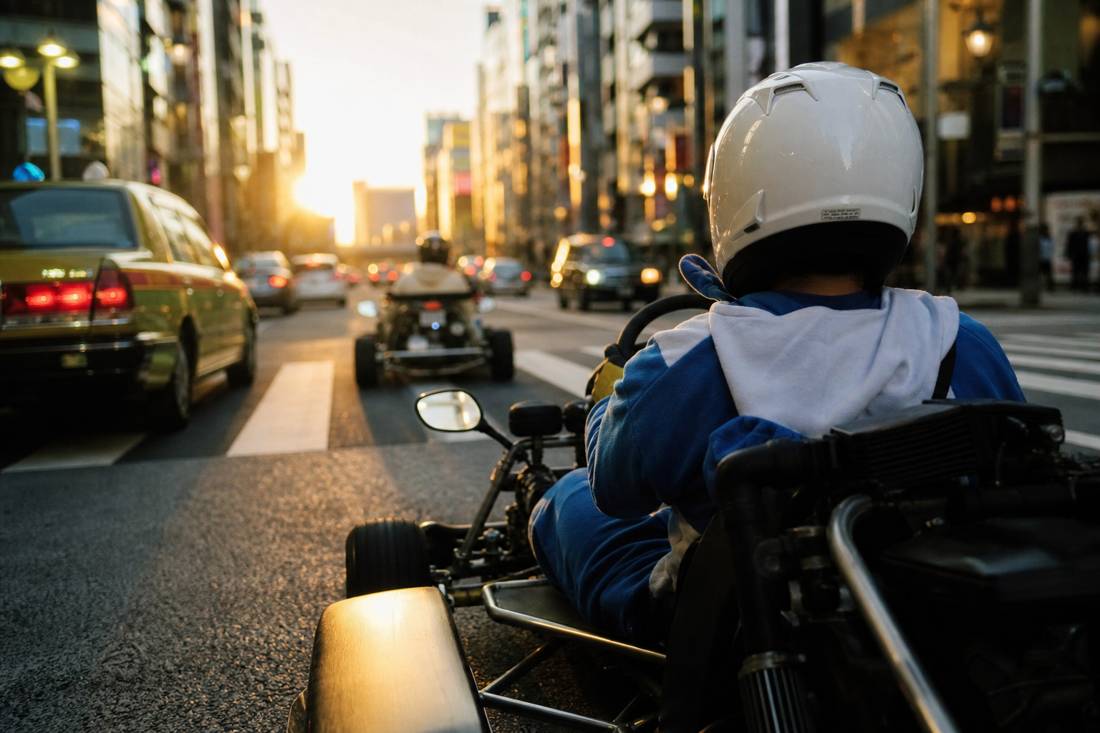
This is the single thing that stops people, so deal with it before you fly. The permit has to come from your home country, since you cannot get one in Japan, and a photo of it on your phone does not count. If you turn up without the valid originals, you cannot drive and you do not get a refund, which is a brutal way to start a holiday.
The six exceptions are Switzerland, Germany, France, Belgium, Monaco, and Taiwan, whose drivers bring an official Japanese translation of their license. I have written the full breakdown, including where to get an IDP, in our Tokyo go-kart license guide. Read it before you book.
Where is the real-life Mario Kart track?
There isn't one. That is the single biggest misunderstanding about this, and it is worth saying plainly: there is no track, no circuit and no theme-park ride. You drive a road-legal kart on Tokyo's actual public streets, in actual traffic, stopping at actual red lights.
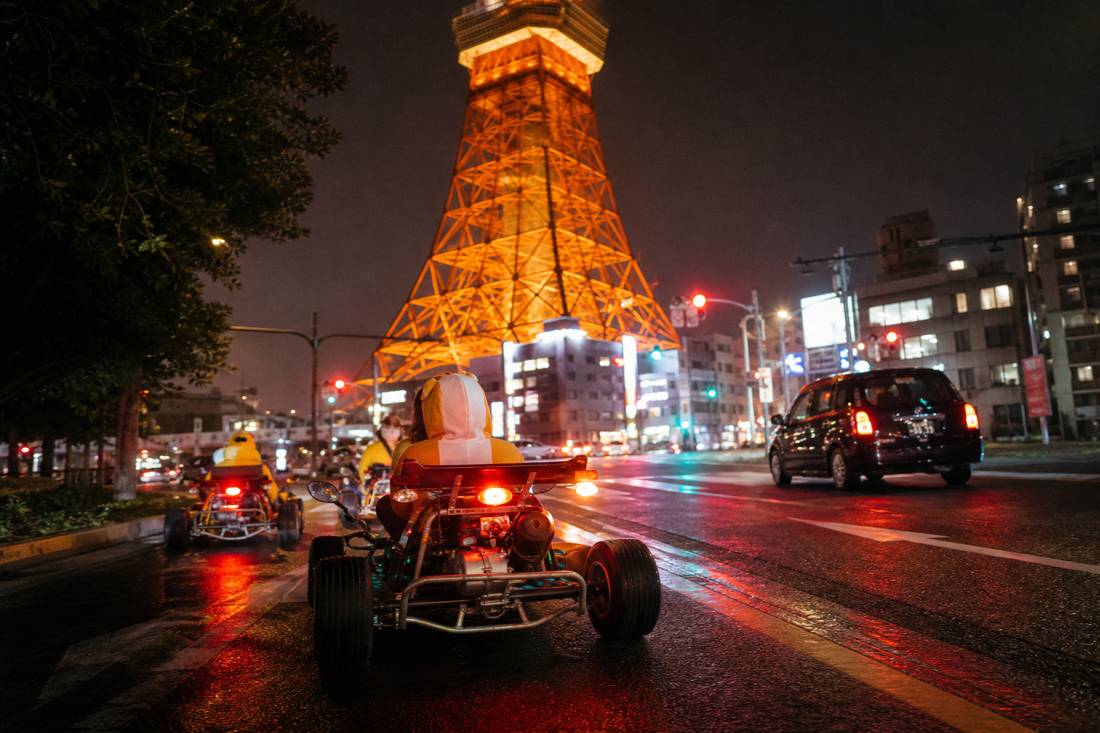
People picture a fenced course with rails and a start line somewhere in Tokyo, and go looking for its address. It does not exist. The "track" is Shibuya, Akihabara, the roads around Tokyo Tower and the Rainbow Bridge: real infrastructure that ordinary cars use, with your convoy threaded into it behind a guide.
Once that lands, most people want it more, not less. A closed circuit would be a go-kart track like any other, and there is one of those in every country. Driving the Shibuya Scramble at eye level with a taxi bumper is the thing you cannot get anywhere else.
Where else in Japan can you do it?
Tokyo is the main event, but it is not the only place. Street Kart also runs in Osaka and in Naha on Okinawa, and other operators cover Tokyo and Osaka too. If Tokyo is the only stop on your trip, you are not missing a better version elsewhere.
Tokyo has the most branches by far, spread across Shibuya, Akihabara, Shinagawa, Asakusa and Tokyo Bay, which is why nearly every video you have seen was filmed here. Osaka is the strongest alternative if your itinerary skips the capital. Okinawa is a different proposition entirely: sunshine and coastal road rather than neon canyon.
For the specific shot everyone is chasing, though, it is Shibuya or nothing. No other city has the Scramble.
Where do you do it in Tokyo?
Two routes capture what people mean by real-life Mario Kart. The Shibuya tour drives the famous Shibuya Crossing, which is the shot almost everyone is chasing. The Akihabara route trades the crossing for electric-town neon and anime billboards, and it costs less. A quieter electric kart is the gentlest way in.
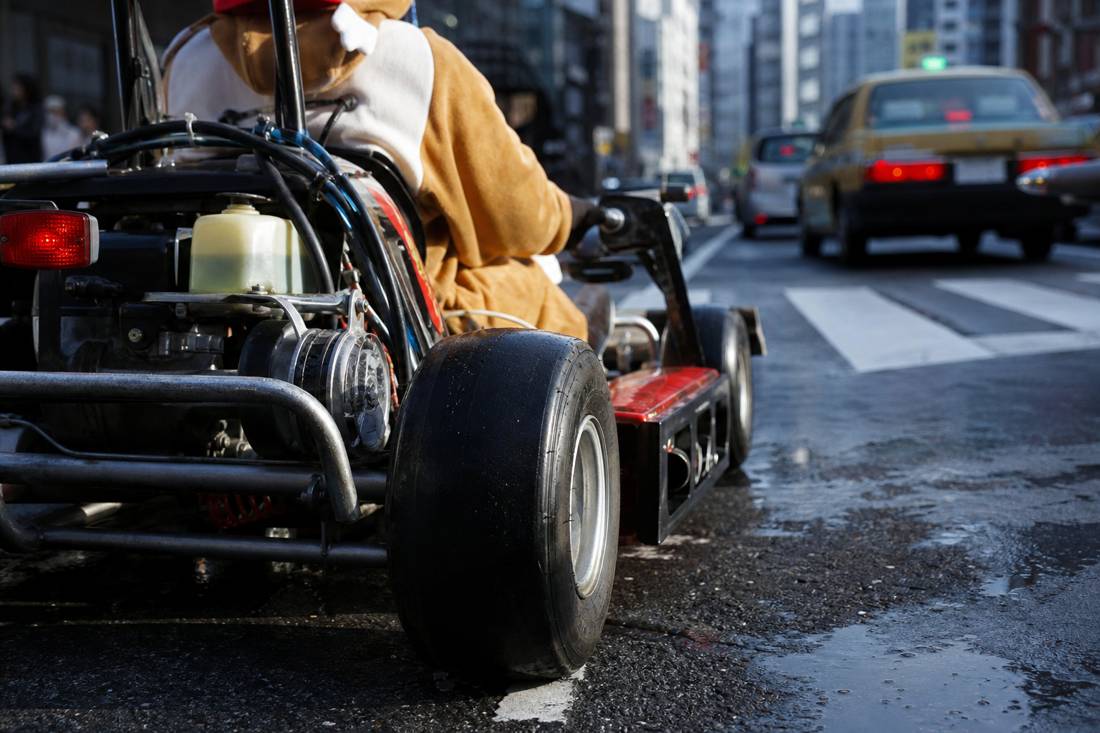
If you only do one and you want the headline memory, take the Shibuya Street Kart Experience and drive the Scramble. If you are an anime or gaming fan, or watching the budget, the Akihabara route is the better fit and the better value, and I map out exactly what that drive is like. You can see all the routes side by side on the tours hub.
Three real tours cover the routes, so match the one to the kind of night you want.
| Tour | Best for | Typical starting price* |
|---|---|---|
| Shibuya Street Kart | The headline memory: driving the famous Shibuya Crossing | around $120 |
| Akihabara go-karting | Value, plus anime and gaming fans chasing electric-town neon | around $75 |
| Electric kart tour | A calm, smoother first drive for nervous first-timers | around $70 |
*Starting prices only. Street kart pricing is dynamic and moves with the date, season and demand, so check the live price on the official listing before you book.
Nervous about traffic on your first go? The electric kart tour is quieter and smoother, and I send a lot of unsure first-timers there while still driving through the crossing. If your worry is the live-traffic part itself, I break down how safe Tokyo go-karting really is separately.
How much does real-life Mario Kart cost?
Budget roughly $70 to $120 for about an hour on the road. The electric kart is the cheapest way in, the Akihabara route sits in the middle, and the flagship Shibuya Crossing run is the dearest. Those are starting prices and they move with the date, the season and how full the slot is, so the live figure on the listing is the only one that counts.
There is no separate track fee, no fuel surcharge and no costume charge: the costume is included, and so are the photos at most shops. What people forget to budget for is the International Driving Permit at home, which is cheap but not free, and the taxi back if you booked a late slot and the trains have thinned out.
Worth it depends on who you are. If dense traffic stresses you or you expected a race track, it can fall flat. If the idea of crossing the world's busiest intersection in costume makes you laugh, it delivers exactly that. The side-by-side comparison helps you match the route to the right traveler, and if you are building a full evening around it, things to do in Shibuya pairs well with a night run.
How do you book it?
Book online ahead of time, after checking your date and the cancellation terms. Bring your license, your IDP or translation, and your passport as originals on the day. Then the only thing left to decide is which costume.
Reserve one to two months out if you are travelling in peak season and want a night slot, because those are the first to sell. Everything else, the kart, the costume, the photos, is handled at the shop, so once your documents are sorted there is very little left to plan.
Choose Your Tokyo Kart Experience
Initial editorial recommendation. Use the optional choices to find a closer fit; eligibility is confirmed by the operator.
Match The Experience To Your Plans
Tokyo Guided Electric Kart Tour: Take a 50-minute electric kart route through Shibuya, Harajuku and Omotesando with photo support. 50 minutes.
Official Street Go-Kart Tour - Akihabara: Follow a guided kart route through Akihabara, Ginza and Tokyo Station. 60–90 minutes, plus arrival 30 minutes early.
Tokyo Shibuya Crossing & Hidden Streets Walking Tour: Explore the crossing, Hachiko, Miyashita Park and hidden neighborhood streets on foot. 2 hours.
Yomiuriland Park Pass: Plan an off-road family park day with Yomiuriland’s family go-kart attraction. Park day, allow additional travel time.
Official Street Go-Kart in Shibuya
Have a travel date in mind? Drive Shibuya Crossing, Harajuku and Omotesando with a guide and photo support. Check your date before arranging the rest of your day.
60–90 minutes, plus arrival 30 minutes early · English
Meeting Point, Inclusions And Restrictions
We are on the street level with neon signs. Returns to meeting point
Includes: All taxes, fees and handling charges; Lead guide in a Kart; Costume Rental Fee; Kart Rental Fee; Fuel surcharge
Extras: Hotel pickup and drop-off; Food and drinks; Gratuities; Full Coverage Insurance Fee
Not recommended for travelers with spinal injuries; Not recommended for travelers with poor cardiovascular health; Not recommended for pregnant travelers; You MUST inform us if you have any level of hearing impairment or mobility impairment.
Adults 18+ only. Required original driving documents and operator approval of suitability apply. No passengers. Public-road driving is not a race or a risk-free activity.